Twice a day, the coastline of Vancouver Island transforms.
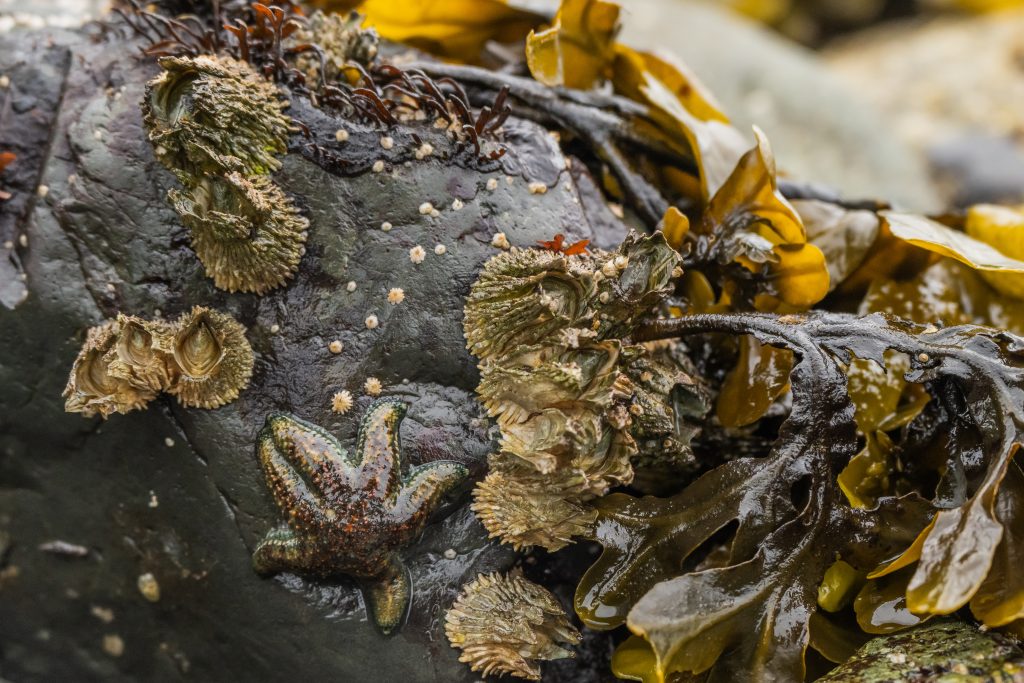
As the tide falls, water retreats from rocky shorelines and suddenly an entire world appears. Sea stars cling to rocks, anemones wait in tide pools, crabs disappear into crevices, and barnacles close themselves tightly against the air. This is the intertidal zone, one of the most fascinating and surprisingly challenging ecosystems you can encounter while exploring Vancouver Island by kayak.
What is the intertidal zone?
The intertidal zone is simply the area of shoreline between high and low tide. At high tide, it is underwater. At low tide, much of it is exposed to the air.
That means the animals and plants living here essentially have to survive in two different worlds. Vancouver Island typically experiences two high and two low tides each day, so intertidal organisms repeatedly transition between being submerged in cold saltwater and being exposed to air. Imagine having your entire neighbourhood disappear underwater every six hours or so!
What lives in Vancouver Island’s intertidal zone?
A lot more than you might think! Vancouver Island’s rocky intertidal areas can support barnacles, mussels, limpets, snails, crabs, anemones, sea stars, sea urchins, chitons, sea cucumbers, small fish, and an incredible variety of algae and seaweeds.
Different species tend to occupy different sections of the shoreline depending on how much time they can tolerate outside the water. Higher areas may be dominated by hardy organisms such as barnacles and limpets, while the lower intertidal can contain colourful communities of anemones, sea stars, urchins, coralline algae, and seaweeds. Look closely at almost any rocky shoreline at low tide, and what initially appears to be bare rock can turn out to be an entire miniature ecosystem.
But living in the intertidal zone requires some impressive adaptations. When the tide disappears, marine animals suddenly have to deal with exposure to air, changing temperatures, predators, and the risk of drying out. Then the ocean returns and they once again have to withstand waves, currents, and marine predators.
Barnacles close their protective plates to retain moisture. Mussels clamp their shells shut and anchor themselves firmly to rocks. Anemones retract their tentacles, while other animals retreat beneath rocks, into crevices, or remain submerged in tide pools until the water returns. The relatively mild climate of Vancouver Island also helps support its remarkable intertidal diversity. Parks Canada notes that the Pacific Rim rarely experiences hard freezes, while nutrient-rich upwelling, stable rocky habitat, and moist summer fog all contribute to the abundance of intertidal life found along the coast.


Why is the intertidal zone so important?
The intertidal zone is much more than the space between the forest and the ocean. It helps connect the two.
These habitats provide food and shelter for an enormous variety of organisms, while animals from outside the intertidal zone also arrive to feed when the tide allows. Shorebirds forage along exposed beaches and kelp forests, while terrestrial animals can take advantage of marine food sources uncovered by the tide. Research on Vancouver Island has highlighted just how important this connection can be, with intertidal habitats functioning as both feeding areas and movement corridors for terrestrial and avian wildlife. In other words, the intertidal zone helps move energy and nutrients between ocean and land.
But the intertidal zone is a vulnerable ecosystem and must be protected.
Many intertidal organisms are surprisingly vulnerable to being stepped on, picked up, moved, or exposed for too long. Even something that looks like an empty shell or bare patch of rock can be part of the habitat. Parks Canada recommends walking carefully, avoiding touching or prying animals from rocks, and leaving shells, stones, driftwood, sea stars, and other natural objects where they are found.


What can you see while kayaking?
One of the best things about exploring Vancouver Island by kayak is how close you are to the shoreline, and even though whales might get most of the attention, but sometimes all you need to do is look down!
At high tide, you might paddle directly above areas that will be completely exposed only a few hours later. At lower tides, rocky ledges, reefs, tide pools, and stretches of seaweed begin appearing around you. Slow down and look closely. You might spot a sea star beneath the surface, an anemone tucked into a crevice, crabs moving between rocks, or a harbour seal resting nearby.
Around northern Vancouver Island, strong tidal changes and rocky reefs can create particularly rich marine habitats. BC Parks notes that areas around the Discovery Islands support sea urchins, sea cucumbers, sea stars, and anemones thanks to the region’s tidal conditions and reefs.