
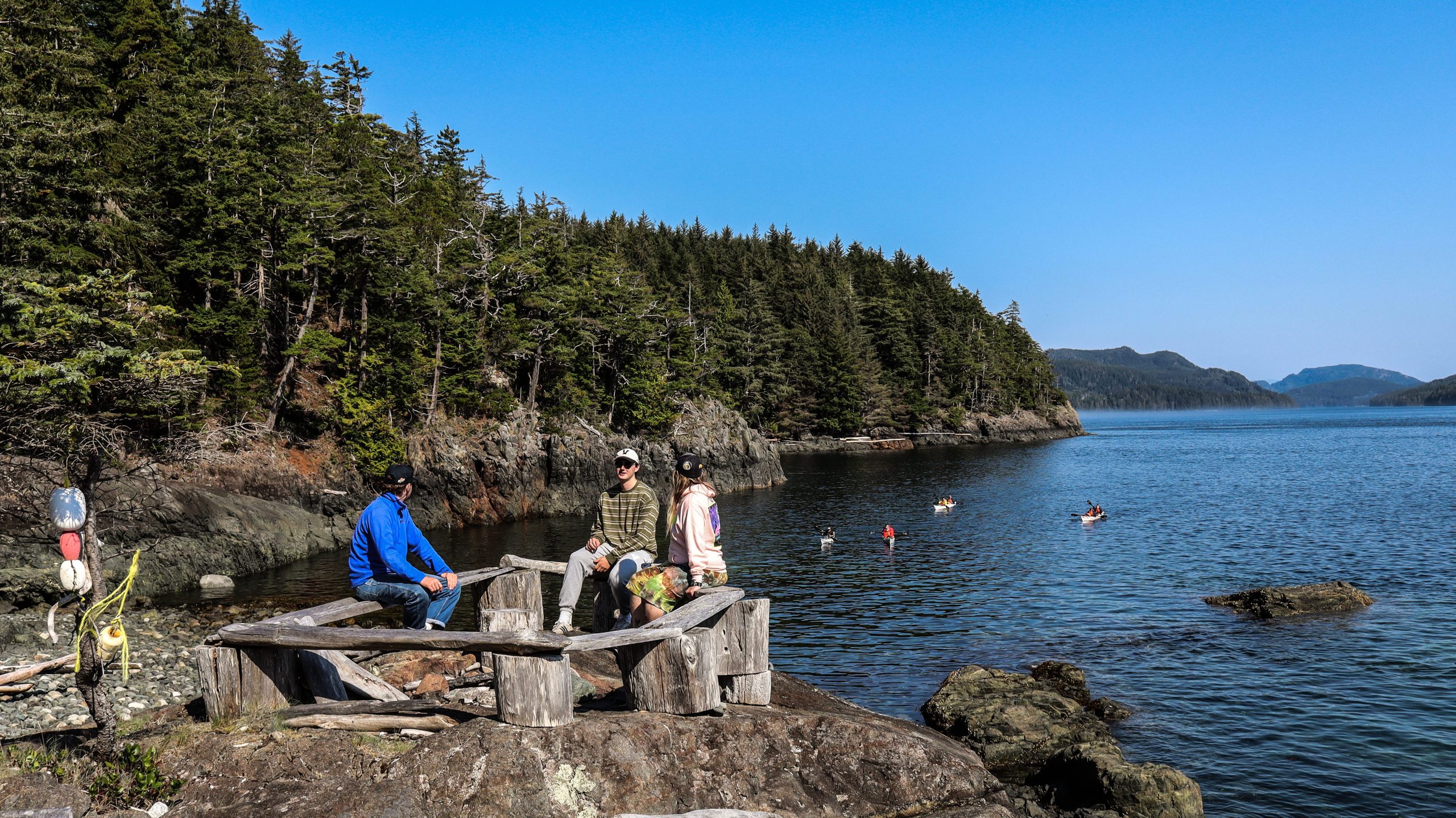
Just a paddle away from Telegraph Cove lies one of the special places we are fortunate enough to explore on many of our multi-day kayaking adventures: Hanson Island!
Surrounded by Johnstone Strait, Blackfish Sound, Weynton Passage, and Blackney Passage, the island sits right in the middle of some of northern Vancouver Island’s most productive marine waters. It is a place of rocky shorelines, dense coastal forest, sheltered bays, and extraordinary opportunities to experience the wildlife of this region from a kayak.
Where is Hanson Island?
Hanson Island is located between Vancouver Island and the mainland coast of British Columbia. Johnstone Strait lies to its south, Blackfish Sound to its north, Weynton Passage to the west, and Blackney Passage to the east. The island is located within the traditional, unceded territory of the Kwakwaka’wakw peoples. Hanson Island is also known by its Kwak’wala name, Yukusam. In Kwak’wala, Yukusam means “shaped like a halibut hook.”
Location is a big part of what makes Hanson Island remarkable. The island sits between several important waterways used by marine wildlife. Weynton and Blackney Passages are narrow, relatively shallow connections between Queen Charlotte Strait and Johnstone Strait. Blackfish Sound, immediately north of Hanson Island, is another exceptionally productive area for wildlife.
Depending on the day and season, the surrounding waters can provide opportunities to encounter humpback whales, killer whales, sea lions, seals, dolphins, porpoises, bald eagles, and other coastal wildlife. As always, these are wild animals moving freely through a huge ecosystem, so sightings are never guaranteed.
For kayakers, Hanson Island also offers something especially valuable: sheltered bays alongside immediate access to much larger waterways. Square Notch Bay, on the island’s northern shore, provides access to both Weynton Passage and Blackfish Sound.
What is OrcaLab?
Hanson Island is also home to OrcaLab, one of the most fascinating pieces of killer whale research history in British Columbia.
Founded by Dr. Paul Spong, OrcaLab has been studying whales from Hanson Island for more than 50 years. Rather than following whales with research vessels, its work is built around a philosophy of observing and listening without interference. A network of remote hydrophones and cameras allows researchers to monitor Northern Resident killer whales and other cetaceans travelling through the waters surrounding northeastern Vancouver Island.
Today, OrcaLab monitors approximately 50 square kilometres of critical habitat and has accumulated more than 60,000 hours of acoustic recordings. Its location on Hanson Island places researchers alongside important killer whale travel routes, including Blackney Passage and the surrounding waterways.
Can you stay overnight on Hanson Island?
On many of our multi-day North Island Kayak experiences, Hanson Island becomes more than somewhere we paddle past. It becomes home for the night. Our Hanson Hide Away Base Camp offers panoramic views toward Johnstone Strait and Robson Bight, while Square Notch Bay on the northern side of Hanson Island provides sheltered access to Weynton Passage and Blackfish Sound.
Spending the night in this environment gives you an entirely different appreciation for the coast. Once the day’s paddling is finished, you are still surrounded by the same forest, ocean, and wildlife you came to experience. There is something very special about waking up on a remote island, stepping outside, looking across the water, and knowing another full day of exploring lies ahead.
Experience Hanson Island by kayak
Hanson Island is much more than a stop on a kayaking route, its location connects some of the most extraordinary waterways around northern Vancouver Island, while its cultural history and connection to decades of killer whale research make it an important part of this coastline.!
For many of our multi-day guests, it is also somewhere they get to call home for a night or more. Paddling its shoreline, exploring the surrounding passages, and falling asleep beside the waters of Johnstone Strait is one of our favourite ways to experience this remarkable part of British Columbia.


